

Industry Insights
Designing for Financial Advisors in the Agentic Era
- WRITTEN BY
- Selma Digital
- PUBLISHED
- Jul, 2026


The Advisor’s New Coworker Is an AI Agent. Is the Software Ready?
AI is changing what financial advisors do all day. The design industry hasn’t caught up yet.
Chatbots Aren’t Enough
Not too long ago, having an unsophisticated AI chatbot tucked into the corner of your SaaS product was enough to claim that your product is “AI-powered” — but many companies have now moved on to bigger things.
Many industry professionals are seeing parts of their workflows being automated by AI, but rarely the entire stack. After the initial worries of AI heavily disrupting workflows among industry professionals (source), many of the same specialists are now eager to adopt AI automation — and the world of financial advising is no exception.
A new generation of AI agents — systems that don’t just answer questions but take actions — is beginning to handle the structured, repeatable parts of an advisor’s day. But when the software starts doing things on the advisor’s behalf, the entire design challenge changes.
What’s Different?
In this new landscape, the design objective isn’t simply to automate as much as possible, but to maintain the trust built around the core services while cutting out the grunt work.
Advisors aren’t worried that AI will replace them. They’re worried about approving something they didn’t fully understand, missing an error that slipped through a bulk workflow, or being on the hook for a recommendation an agent generated. This new source of potential compliance issues is the new problem we’re designing around.
In the world of financial advising, simple mistakes cost clients real money. Without proper safeguards, hallucination rates on financial AI tasks run between 15–25% — and when errors do slip through, firms report individual incident costs ranging from $50,000 to $2.1 million. Compliance feasibility remains the hurdle every wealth management tool has to face, but those that do become the ones that are deeply embedded within the space.
Good agentic design has to answer three questions the old software never needed to ask:
1. When should the advisor be in the loop?
Not every action needs a human checkpoint, but some absolutely do. Drawing that line clearly, and making it visible, is one of the hardest UX challenges in this space.
2. How does the advisor know what the agent is thinking?
Output alone isn’t enough. Advisors need legible signals about how confident the agent is, what it based its reasoning on, and what are the steps it took to get there.
3. What happens when something goes wrong?
The reality is agents will make mistakes, which is why the interface needs to make those mistakes catchable, correctable, and auditable. In a regulated industry, it’s a non-negotiable.
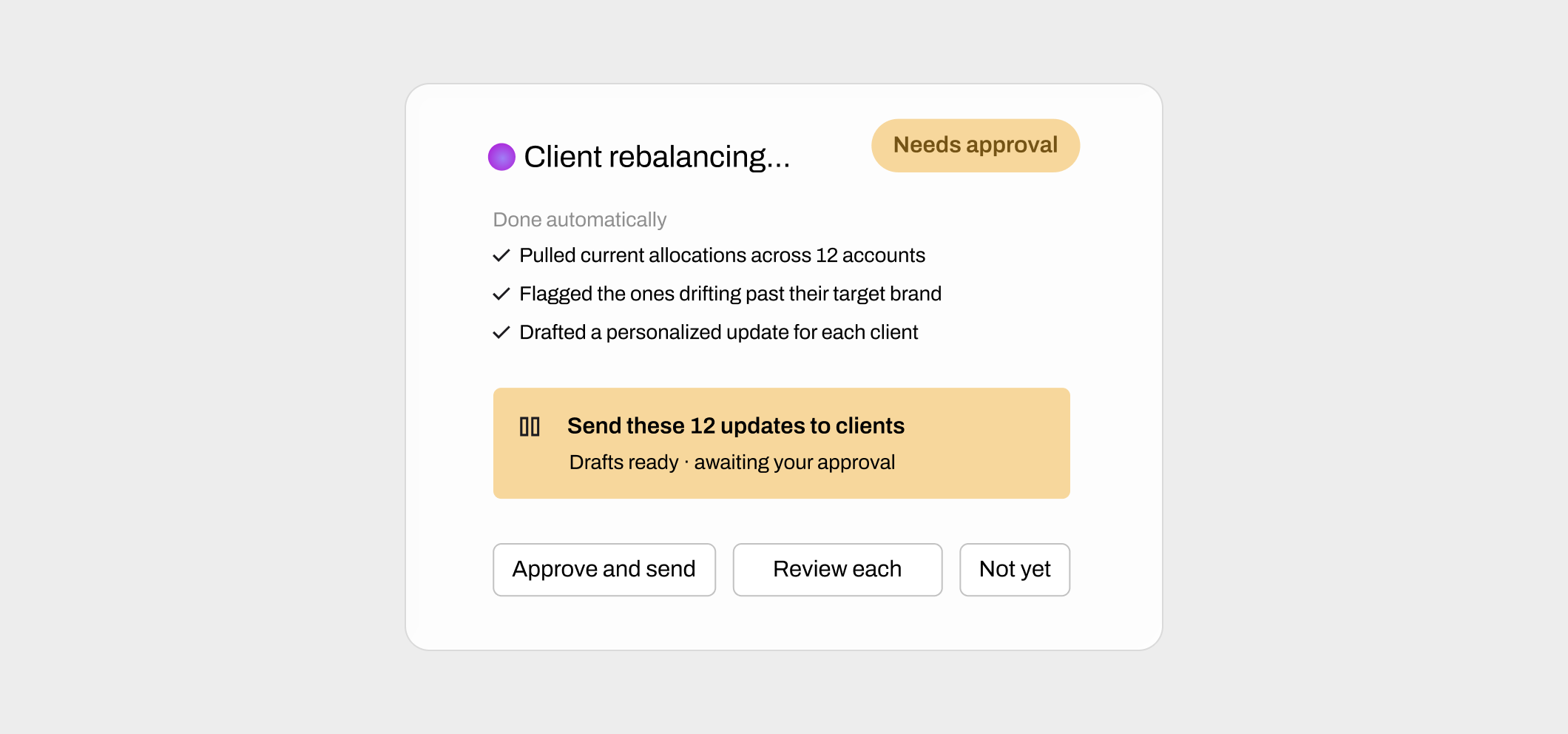
What’s Actually Getting Automated (And What Isn’t)
The parts of advisor workflows that are being automated first share the same characteristics: high-volume, structured, time-consuming, and not the reason anyone became a financial advisor in the first place. Client communication drafts, meeting prep summaries, and compliance documentation are the early targets — and advisors who’ve experienced good implementations of them largely share the same reaction: I got hours back, and I used them with clients.
What isn’t being automated is the core of what makes a great advisor: navigating a client through a divorce, talking someone off the ledge during a market drop, and building the kind of trust that earns a 30-year relationship. No agent is touching that, and the best platforms aren’t trying to.
What This Means for the Industry
Agentic design isn’t just speeding up an existing process but is allowing financial advisors to builder deeper relationships with their clients. However, this shift can’t be entirely attributed to the innovations brought on by new technology alone, as this has been the aim of financial advisors and the tools they trust from the very beginning. In this new design space, we’re now designing for the AI features that advisors will fall back on — while being wary of the features that shouldn’t take the wheel quite yet. In the end, how these new tools for financial advisors will evolve won’t feel like a leap into the future — but the software finally getting out of the way and the advisor coming forward.

